Accessible housing
A home is accessible when it is usable for individuals with disabilities. Because disability is so diverse, a wide spectrum of accessibility needs exist, including homes that are accessible to people with difficulty walking, people using mobility devices, and people with visual or auditory impairments.
The federal government defines specific standards for accessibility that vary depending on how the development is funded; however, these standards are often not sufficient to meet the full range of needs of people with disabilities. The concept of Universal Design goes beyond basic ADA accessibility requirements, and leans into designing a space that is truly welcoming and dignified for all people. See Community Vision’s Universal Design Guidebook for more information.
Accessory dwelling unit (ADU)
Accessory dwelling units (ADUs) are small homes that exist on the same lot as a single family residence. They come in many shapes and styles, and have increasingly become a popular option for young adults, seniors, people with higher support needs, and other people at various stages of their lives.
Adaptive housing
Adaptive housing refers to homes that are designed to be adaptable to the changing needs of occupants. As residents age or acquire disabilities, adaptive housing can be modified to accommodate their changing needs. However, the cost of modifications usually falls on the tenant.
Affordable housing
Many misconceptions exist about what affordable housing is, probably because this phrase is used in many different ways to mean different things.
When we refer to Affordable Housing (capitalized) we are referring to subsidized housing that is restricted to people at or below a certain income level, often listed as a percentage of area median income (AMI). Many different federal, state, and local programs subsidize Affordable Housing, including housing vouchers, Low-Income Housing Tax Credits (LIHTC), and other forms of financing.
We also often talk about housing affordability, or non-subsidized affordable housing (lower-case), which refers to general affordability across a range of income levels. The commonly-used definition of housing affordability means a family should be paying no more than 30% of total income for their rent or mortgage, including utilities. When a household pays more than 30% of their income to housing costs, they are considered “cost-burdened.” When a household pays more than 50% of their income to housing, they are considered “severely cost-burdened.”
Different agencies and programs use the term affordable housing in different ways, so make sure to check how it is being defined in a specific context.
Area Median Income (AMI)
Area median income (AMI) is the key data point that most Affordable Housing programs use to determine eligibility for families and individuals. It refers to the income of a statistically average household. In other words, if you were to line up every household in a region from poorest to wealthiest, the one in the middle would be the median household.
We also often refer to a percentage of the AMI, which represents a specific income band. For example, “60% AMI” refers to people making 60% or less than the median household.
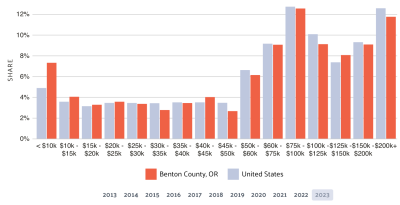
For example, for all households in Benton County, the income distribution can be seen in this graph below. In 2023, the middle income, or median income, was $76,011.
| Percent AMI | Designation | Household Income |
|---|---|---|
| 30% | Extremely low-income | $23,753 |
| 50% | Very low-income | $39,589 |
| 80% | Low-income | $63,343 |
| AMI (100%) | Workforce | $79,179 |
| 120% | Moderate income | $95,014 |
This means that a Benton County resident working full-time at minimum wage ($15.05) would be making $31,200 per year and would be grouped in the 30-50% AMI category if living alone. This might qualify them for certain low-income assistance programs, if those programs are funded and available.
If you’re interested in knowing the AMI for your county, use the Fannie Mae Area Median Income Lookup Tool or refer to the US Census Bureau for more detailed information.
| AMI | 30% | 60% | 80% | AMI | 120% |
|---|---|---|---|---|---|
| 80–90k | Restaurant employee | Construction worker | Teacher | Retail Store Manager | IT Manager |
| 90–100k | Certified Nurse Assistant | Paramedic | Registered Nurse | Firefighter | Pharmacist |
| 100–120k | Amazon delivery driver | Accountant | Dental Hygienist | Engineer | University Administrator |
Housing Accountability and Production Office (HAPO)
The Housing Accountability and Production Office (HAPO) is a new initiative established by the Governor’s housing production package that will pave the way for innovative solutions that enhance housing affordability and accessibility for all Oregonians.
HAPO ensures compliance with state housing laws, supports local governments in navigating state resources and processes, and improves housing production through research and guidance. Cities, counties, developers, and advocates can get support from HAPO on understanding and navigating housing laws or state policies, programs, and resources to support housing production by submitting an inquiry to their intake form.
HAPO maintains a Housing Production Resource Hub, which provides an online resource for local governments, developers, and advocates to support housing production. The site links to a wide variety of housing, planning, and infrastructure grants, loans, tax credits, technical assistance, and practical resources for cities and counties across Oregon.
Middle housing
Middle housing refers to the homes in the “middle” of the housing spectrum. It is also referred to as “missing middle housing” due to its lack of availability in most communities. Oregon defines the following home types to be middle housing: duplexes, triplexes, quadplexes, cottage clusters, and townhouses. These home types are an essential component of the housing spectrum, and provide important options for people of various income levels and stages of life.
“Naturally occurring” affordable housing (NOAH)
Sometimes, people refer to non-subsidized affordable housing as “naturally occurring” affordable housing (NOAH) to indicate that no market subsidy was necessary to achieve below-market home cost. However, all housing affordability is the product of policy choices made over many decades. In addition, people living in this type of housing may be vulnerable to displacement pressures, and policymakers should consider ways to preserve existing affordable housing and prevent neighborhood gentrification.
Needed housing
When we refer to needed housing or needed homes, we are referring to the homes that a community lacks and needs to see produced, in the locations people need to live, and of the types, sizes, accessibility and affordability levels that people need. Cities are required to analyze and plan for needed housing.
Oregon Housing Needs Analysis (OHNA)
The Oregon Housing Needs Analysis (OHNA) is a comprehensive system for analyzing communities’ unique housing needs and developing local strategies to promote housing production, affordability, and choice. The adoption of OHNA represents a major shift in Oregon’s housing planning framework and brings Oregon much closer to fulfilling the promise of statewide land use planning Goal 10—Housing for All—in every neighborhood.
Permanent supportive housing (PSH)
Permanent supportive housing (PSH) is an important aspect of helping people become housed: By combining Affordable Housing with voluntary support services, people are better able to access and maintain stability over time. PSH provides an additional step beyond the initial construction, because it also requires ongoing staff capacity to support the individuals or families living in these units.
System development charge (SDC)
Most local governments require housing developers to pay a system development charge (SDC), which pays for the installation of infrastructure such as sewer and water lines. Learn more.
Wildland-urban interface (WUI)
The wildland-urban interface (WUI) is the transition zone between wilderness areas and human development. This is especially relevant in communities at risk of wildfire, because homes and other buildings in the WUI face the highest level of danger. Learn more.
Workforce housing
Workforce housing is a term used by some planners and policy makers to describe the housing needed by the workers in a community, often used in the context of economic development. There is a strong overlap between workforce and affordable housing, since most people living in affordable housing are also workers, and in some cases the term “workforce housing” is used as a replacement for the term affordable housing because there is less stigma associated with this phrase.
There is no commonly agreed upon income range for workforce housing, but it is often used to refer to homes affordable to people in the 80-120% area median income (AMI) range. Workforce housing may be for sale or for rent, may or may not include subsidy, and may or may not be owned by an employer.
Different jurisdictions and organizations use the term workforce housing differently, so always make sure to check how they are defining it.