By Sam Diaz | 5.5-minute read
Update, March 5, 2026: SB 1586 was defeated. See Grassroots effort defeats controversial urban growth boundary expansion and corporate tax breaks.
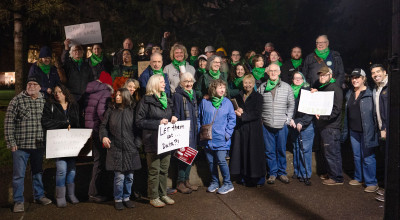
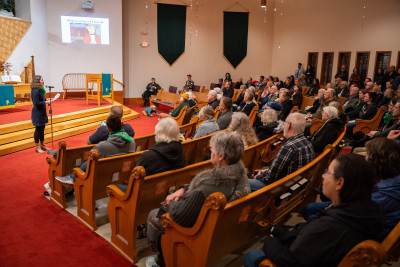
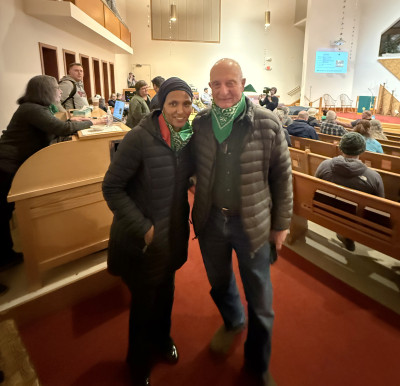
Just days before the 2026 legislative session officially began, over 200 Oregonians filled the pews in Forest Grove’s United Church of Christ to learn more, organize, and advocate against Senate Bill 1586. Brought forward primarily by Oregon State Senator Janeen Sollman, this bill proposes to expand Hillsboro’s urban growth boundary (UGB) by over 1,700 acres for industrial development.
The land in question is farmland—and not just any farmland. It has some of the best soils in the world, which can grow a wide array of crops. Unsurprisingly, community members have opposed all previous attempts to develop this farmland and they are mounting a strong campaign opposing SB 1586—the sixth time legislators have tried.
When the program about SB 1586 started, the pews were full and people were lined up along the church walls, intently focused on the words of local community leaders speaking about the potential impacts of this legislation.
Here's what they had to say:
Faun Hosey, long-time civic leader of Save Helvetia
“This rural reserve represents some of the best soils in the world, literally. Irrigated or not irrigated, there's nothing better anywhere. By now half of these have already been urbanized in Washington County.”
As a leader in the coalition Save Helvetia, Faun Hosey has been deeply involved in the grassroots fight for prime farmland. A current focus is the land protected in the rural reserves established by the 2014 Grand Bargain (HB 4078). She shared details of the history of the reserves map-making process. A progression of maps served to illustrate the soils of Washington County as well as the creation of urban and rural reserves maps for regional long-term planning.
The Grand Bargain, intended as one-time-only land use legislation, brought more than 2,400 acres of prime farmland into Hillsboro's UGB for industrial and residential development—skipping the usual urban reserves designation for the 50-year supply. SB 1586, the so-called Oregon Jobs Act, proposes to break this 50-year promise of protection and undo that 1,700-acre rural reserve.
Nellie McAdams: Local farmer, attorney, and nonprofit leader
“We have plenty of industrial land inside our cities. Urban growth boundaries around the state have more than 10,000 acres of unbuilt industrial lands already, including 500 acres just west of this site in Hillsboro. Hillsboro has used up hundreds of acres for low-employment industries like data centers... That’s a waste of our tax dollars and natural resources.”
Nellie shared data point after data point explaining why SB 1586’s alleged reasons to pave over 1,700 acres of rural reserves doesn’t add up.
A 2023 survey spearheaded by Oregon Economic Development Association, League of Oregon Cities, and Oregon Business Council (along with testimony submitted by Oregon cities to the Joint Committee on Semiconductors) indicates that Oregon has almost 10,000 acres of industrial land inside our existing urban growth boundaries. (Additional city and planning documents indicate that the acreage is actually over 10,000.) The survey and testimony also showed that there are sites of all sizes, including large sites (500 acres+) in multiple Oregon towns, including Hillsboro, Wilsonville, Medford, and Redmond.
As Nellie shared, the main barrier for these lands to be developed would be investment in basic infrastructure: Sewer, water, lighting, and roads. But SB 1586 doesn’t address that actual barrier; it just proposes paving over farmland and adding costs to the state’s already-tight infrastructure budget.
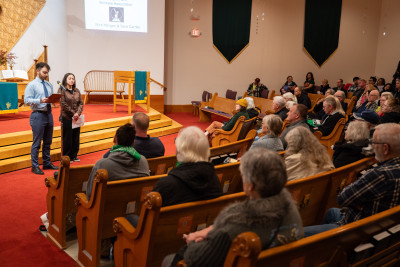
Nick Morgan and Sarah Carillo, Western Farmworker Association
“The reason for our growing poverty conditions are not isolated from the state’s policy of corporate welfare for data centers and the tech sector... We are the ones who pay for the infrastructure with the electricity rate increasing by 50% in just 5 years… We need food farms, not data farms.”
Nick and Sarah shared experience after experience of Washington County heading in the wrong direction with outdated, out-of-touch approaches just like what is outlined in SB 1586. Legislation like this doesn’t lead to great jobs for people; it leads to higher energy and water bills, new fees to keep basic services open like the libraries, and out-of-work farmers and farmworkers.
And if the people who pick our food, clean our schools, libraries, and office parks, and serve us at the restaurants are taking issue with SB 1586, then you’re on the wrong side of the conversation in my book!
Nafisa Fai, Washington County Commissioner
“Farming has remained our number two industry and our biggest source of green jobs because farmers innovate to grow new crops, to better use their equipment, and to rise to the challenge of producing food that we can eat while taking carbon and (other) greenhouse gases from the air to protect our climate. And unlike data centers, we can’t relocate these farmers to old Intel campuses.”
To cheers and applause from the audience, Commissioner Fai shared her commitment to economic development that actually centers residents’ quality of life, sound financial decisions, and public engagement. For many, Commissioner Fai represented the best of government that evening: She expressed her continued investment in listening and responding to her constituents, asking good questions about the impacts of this far-reaching legislation, and inviting all of us to be strategic in how we use our land, public infrastructure dollars, and time.
See more of Commissioner Fai’s remarks (Hillsboro Herald).
Now that we’ve heard from these local leaders, separated truth from myth, and really analyzed the impacts that would come to us as Oregonians if SB 1586 is passed… what’s next?
Here is what we’re focusing on and how you can help:
- Submit testimony opposing SB 1586. This situation is evolving quickly, so refer to our legislative docket for the most current recommendations and details.
- We’re working in coalition to defeat this bill, including with the Oregon Conservation Network.
- 1000 Friends of Oregon staff is sending in maps, updated industrial lands inventories, meeting with legislators and legislative staff, and fielding media and community inquiries. Want us to speak to your organization, office, or community about this issue? Have resources to share with us? Please let us know.