
By Anna Kemper | 2.5-minute read
Earlier this month, 1000 Friends of Oregon joined AARP Oregon, Community Vision, and Sightline Institute to host a webinar on accessible housing policy and advocacy in Oregon. The conversation brought together 86 advocates, planners, policymakers, students, housing providers, and community members to explore the fact that while the need for accessible housing continues to rise, there is still widespread confusion about what “accessibility” actually means and what policies currently exist.
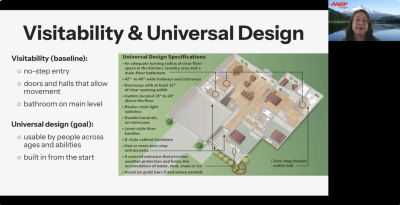
The webinar featured presentations from Allen Hines of Community Vision, Bandana Shrestha of AARP Oregon, and Cassie Wilson of 1000 Friends of Oregon who helped unpack the differences between accessibility standards and universal design while addressing common myths about costs and feasibility.
“You think you have time to figure it out, but you can become disabled at any age.”
–Event participant
Disability, aging, injury, chronic illness, and changing mobility needs affect people across every stage of life. As one attendee shared during the discussion, “You think you have time to figure it out, but you can become disabled at any age.”
Bandana opened up her section of the webinar by asking folks that if they suddenly broke their leg, would their home be accessible for them without modifications? The response in the comments was overwhelmingly, “Nope.” As with Bandana’s example, even if someone normally is able to access a second floor, a leg injury would make steep stairs to an upper level incredibly difficult to navigate.
Attendees also discussed the idea of social isolation due to limiting built environments. The reality is that even people who have accessible homes may still be unable to visit friends or participate fully in community life if other buildings are inaccessible.
The webinar also covered how Oregon’s current accessibility policies can often fall short. Cassie gave an overview of barriers created by elevator and stair regulations, the lack of accessible housing inventory tracking, the challenges of funding retrofits and affordable housing, and the need for more robust statewide conversations around building codes. She noted that while Oregon cities are limited in their ability to adopt building code requirements beyond state standards, there are still opportunities for advocacy around statewide policies.
From supporting accessible housing legislation, to sharing your housing experiences with lawmakers, to auditing your own space for accessibility, to staying connected through newsletters from 1000 Friends, Community Vision, and AARP, there are many ways to help champion accessible, inclusive housing in Oregon communities.
The presenters and following question and answer session challenged assumptions about accessibility features themselves. Many accessibility improvements like step-free entrances, grab bars, and electric doors benefit everyone—not just older adults or wheelchair users.
One thing was clear as the hour and a half conversation came to an end: There’s a lot of change needed, but there’s a great community of advocates ready to do the work together.
Watch the full webinar recording
Additional resources
Below are a number of resources shared during the webinar for those interested in learning more about accessible housing, universal design, and livable communities:
- 1000 Friends of Oregon's Housing Solutions Center
- Accessible Housing Policy for Advocates webinar (slide deck)
- Word Cloud from Accessible Housing Policy for Advocates webinar: “What does “accessible” mean to you?”
- Elevator Reform Coalition
- VIDEO: North America’s Elevator Problem
- ARTICLE: Washington State Leads on Elevator Reform
- ARTICLE: Washington Passes First Statewide Scissor Stair Reform
- Future of Housing Initiative
- AARP Universal Design Report
- AARP Livability Index
- AARP Livable Communities Resource Hub
- AARP Livable Communities Newsletter
- AARP Livable Communities Map
- AARP Livable Communities Library
- VIDEO: Apartment Tour: Are Oregon's Accessible Units Actually Accessible?