By Jenni Denekas | 6-minute read
We are celebrating the anniversary of Governor Tom McCall signing Senate Bill 100 and SB 101 into law on May 29, 1973. Respectively, these created the land use system that has shaped our state for over 50 years, and implemented protections for Oregon's agricultural lands.
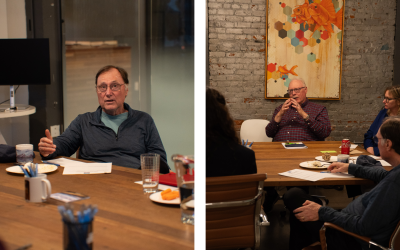
We are also celebrating our colleagues’ decades of impactful work and deep organizational knowledge—including 1000 Friends of Oregon Working Lands Policy Director Jim Johnson and board member Jeff Mapes. Each of these men, in their respective disciplines, have worked closely with our land use system for over 40 years.
Jim’s background is land use planning, including 28 years as the Land Use and Water Planning Coordinator at the Oregon Department of Agriculture and being a planner in Wasco County “during the Rajneeshpuram days.” His primary focus is farmland and forest land protection. As Jim says:
“There's nothing like [our land use system]. I've been asked to study farmland protection and forestland protection around the world, and there's nothing like what we do here, any place else.”
Jeff, now retired, was a journalist at The Oregonian for over 30 years, where his primary focus was “politics and legislature, which you can't do without also covering land use.” Jeff also worked at Oregon Public Broadcasting, where he created “Growing Oregon,” a six-part multimedia series about Oregon’s land use program, and he published a book, Pedaling Revolution, about bicycle advocacy and its intersection with urban planning.
Connecting with the next generation of land use leaders through shared values
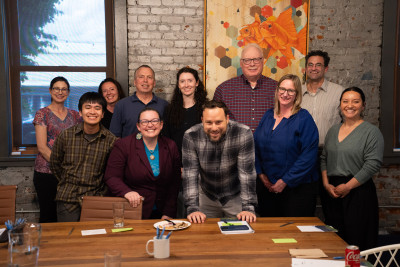
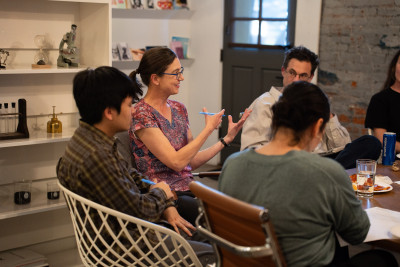
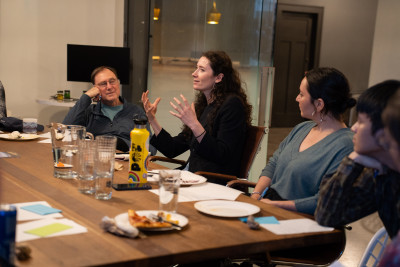
These two esteemed members of our 1000 Friends community took part in a recent story circle with our 2026 Land Use Leadership Initiative (LULI) cohort and staff about how to facilitate intergenerational collaboration. Co-facilitated by Communications Manager Jenni Denekas and Membership Experience Manager Sofia Baum, this group conversation focused on ways we can share knowledge and ensure that our land use system remains strong for the next 50 years—and beyond.
“It's going to be really important that new people like you all get involved and carry this (land use) tradition on,” Jim said to our LULIs at the start of the group discussion. “And I think we need to make sure that people understand that it's not just about regulation, but it's about a vision. It's a comprehensive plan, a plan for the future.”
In that spirit, the first portion of conversation was rooted in identifying shared values—including Oregon’s 19 statewide land use planning goals. These have provided a flexible but enduring framework for land use decisions since 1973. As stated by LULI cohort member Providance Nagy:
“Having that foundation of values is an important part of successful intergenerational collaboration. There's a lot of competition, fighting over limited resources, and creating a collaborative space is important. We could look at it as we say in the military, ‘One team, one fight.’”
Creating opportunity on both sides of the urban growth boundary
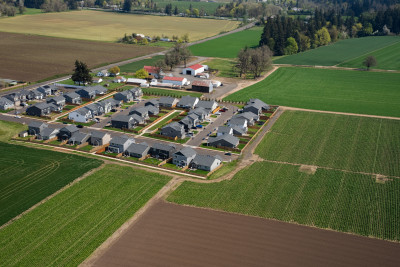
Another prominent part of the conversation was the importance of urban growth boundaries (UGBs) as a way to create opportunity on both sides of the line. As Jim says:
“We can't have successful cities without successful farmland protection, and we can't have successful farms without successful cities."
UGBs help to create compact cities that make it easier for residents to meet their basic needs nearby. When a UGB is paired with infrastructure that creates opportunities to walk, roll, and ride transit, this can also increase residents’ total daily exercise, create safe and intentional opportunities for community connection, and make for more affordable living because of the reduced need to drive a car (which is better for climate change, too).
“There's a real community sense behind Oregon’s land use system,” said Robb Wolfson, Legal Apprentice and 2001 Gerhardt intern. “This is true in terms of the way cities are formed, but also in terms of farmland protection.”
The agricultural side of the line is protected by UGBs and also by the exclusive farm use (EFU) designation. EFU lands are designed to provide what Jim calls “factories without walls” plenty of space to operate without interference. For instance, EFU zones help to insulate agricultural operations from issues like noise complaints (which could result from residences being located too close to farmland), or heavy traffic (which can pose hazards to workers moving farm equipment). At the same time, EFU lands create scenic vistas that can positively impact quality of life for all Oregonians.
“When my husband and I first moved from Utah, we lived in the suburbs and without knowing anything about the land use program, when we’d drive to the coast, it was very tangible Oregon is really making an effort to have farmland close to its cities,” said Digital Communications and Engagement Manager Sarah Yeoman. “When you connect the ‘why’ to what you're actually visually seeing, it makes so much more sense.”
This is true for born-and-raised Oregonians as well, as LULI cohort member David Hoang shared: “I grew up in Portland, in the city, on a busy street, next to a convenience store, so I've always felt a little bit disconnected to nature. But thanks to our UGBs, I'm lucky to have the option to experience both the city and quiet agricultural life. Having that access and those options is important.”
Identifying threats to the land use system
As noted by LULI cohort member Joan Petit, scenic landscapes can be difficult to access for many Oregonians: “Talking about intergenerational stuff makes me think of my kids, who are 23 and 21, who, as they come into adulthood, are coming into such a different set of circumstances than what I had when I was young. There are some real economics for this generation that aren't working right now, and the idea of experiencing nature is really a lot more abstract, because they're working so much just to be able to afford rent.”
LULIs and longtime land use proponents alike also noted that a lack of public awareness of how the land use system works—and in some cases, a lack of awareness of its existence or role in Oregon’s unique character—is a critical threat to the ongoing work of stewarding this statewide program into the future.
“I know a lot of folks who do a lot of work in bicycle advocacy, pretty wonky people,” Joan said. “I was talking to a friend last night who hadn't heard of Oregon’s 19 land use planning goals. She could tell you all about Portland's transportation system plan, but she didn't know where that stuff came from.”
This reflects a critical change that has occurred in the past few decades across multiple sectors. In particular, Jeff noted that significant changes in the world of journalism—including the loss of many local newspapers—have reduced the amount of, and nuance in, coverage about land use. As Jeff explained:
“When I first came to Oregon in 1984, people were much more attuned to the [land use] system because it was much more in the news. It's always been a hard topic for, say, TV news and social media because it is so complicated.”
Individualistic and short-term thinking were also cited by multiple group members as threats to the land use system.
“I think people just have these blinders on and they don't see the big picture about their place in the world, or even history, and how fast this world is changing,” said LULI cohort member Carl Smith. “Most people just look at what's going on and say, ‘Oh, this is just how the world is.’ But that's just how it is right now. It's about the wide view for all of us.”
Hope for the future begins with community care
“I think COVID accelerated a decline in community care,” said LULI cohort member Bess Waldram. “But the more that we can tie together a sense of community to what it means to be in a place, living closely together, and to education about the land use system, there could be a great opportunity there.”
And fortunately, there are already many efforts we can learn from and build upon.
“Just look at what happened out in North Plains with the UGB and data center stuff, and how the community came together to fight that,” said Jim, referring to the grassroots effort that defeated SB 1586 earlier this year. A coalition of community groups, including 1000 Friends, staved off an effort to expand Hillsboro’s UGB onto 1,700 acres of world-class soils that are being actively farmed by over 30 businesses.
That victory reflects a broader truth, as expressed by LULI cohort member Ian Rees:
“Preserving the coast, the waterfalls, the old-growth forests, the starry night skies, and the bountiful farmland are all worth fighting for, and none of that has to be at the expense of economic development. We use economic development as a reason why we can't do it. But there's a way to have both.”
Learn more about our 2026 LULI cohort
Read more about how we can combine economic prosperity with land stewardship