
By Jacky Lee | 10-minute read
On a foggy evening in Astoria earlier this month, a group of residents called Astoria Housing for All hosted a community forum to launch their new housing initiative. The event was at the Anita Building, a tucked away art studio downtown. Upon entering, there were stickers on tables that said, “Your second home lives here full-time,” and “House everyone now.” A group of residents welcomed new arrivals and invited us to try the homemade snickerdoodles. A sign by the cookies read, “Like housing, please make sure everyone gets one before you get seconds.”
This was the theme of the evening: In a community where one in seven homes are vacant or seasonally occupied, full-time residents and workers still struggle to find, or are unable to find, places to stay. By the time the presentation started, the room was full—about 20 people in chairs and 10 standing in the back, all excited to hear more about the new initiative.

Who is Astoria Housing For All?
Learn more about Astoria Housing For All
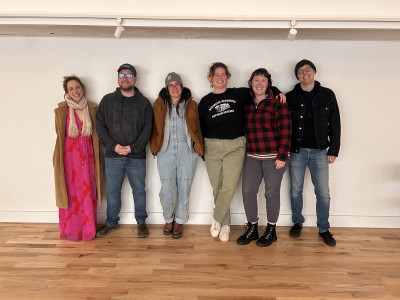
Astoria Housing For All is a group of six residents who came together around a big idea. Most of them didn’t know each other before they started working on this campaign, but they have formed a close group since starting the process last summer.
What unites all these residents? A love of place. Their love of Astoria shines through the policy conversation. They are united by a strong desire to make sure they and their neighbors, coworkers, family, and friends are able to stay in the beautiful coastal community that draws so many of us to visit.
Emily Barber introduced the group:
“None of us are industry experts, none of us have ever run a ballot initiative before. We’re just a group of residents who care.”
Despite their humble attitude, these residents have clearly done their homework, and have a deep understanding of the problems impacting their community and what policy tools can be leveraged.
Emily is a receptionist, a renter, and someone just barely making it work, “thanks to the kindness of family and friends and the exhausting creativity of living in survival mode.”
She has lived in Astoria for five years, mostly housing insecure. She has spent two years living in a trailer, and only recently moved back into an apartment with housemates.
The Astoria Housing Initiative
Astoria Housing for All is working on a ballot measure that will be sent to Astoria voters this fall. The first component of the Astoria Housing Initiative is the Empty Homes Tax, which is a local excise tax on homes that voluntarily sit vacant for more than 182 days in the year (mostly vacation or second homes). The second is the Community Housing Fund, which gets its revenue from the tax. The fund will be used to support a variety of community housing goals. This big idea is powerful and innovative; no other city in Oregon has passed an empty homes tax yet, despite its strong potential.
Astoria’s Housing Crisis
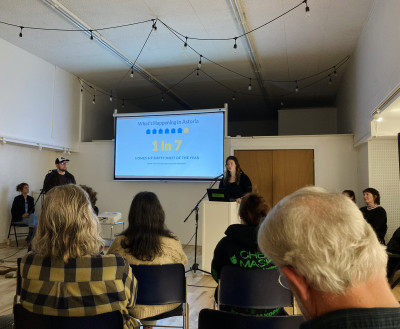
Caitlin Seyfried shared an overview of the housing need in the community, which is immense. In Astoria, one in seven homes is vacant. One in two residents is housing cost burdened, meaning they pay more than 30% of their income on rent or mortgage costs; and one in four residents is severely cost burdened, meaning they pay more than 50%. As a whole, Astoria is one of the most rent burdened cities in the state.
“Everyone’s rent is too high,” said Caitlin, describing the stress of paying extremely high rent—even for moldy or decrepit homes—which prevents residents from living full lives.
When people are paying this much money on housing, they’re often cutting back on other basic needs like food, home heating, healthcare, transportation, and other everyday essentials. This is not conducive to sustaining a healthy community. Housing is a foundational human need. All people deserve the dignity of living in homes they can afford in the community they work in.
“We also know friends that have fallen through the cracks, and it’s hard to see,” Caitlin said.
Having enough housing people can afford is a community-wide issue. It impacts schools, businesses, workers, and the entire community.
“To have a thriving town, you need to make sure the housing supports the people that live and work there,” Caitlin said.
But this isn’t just a shortage that impacts low-income people: The local hospital struggles to hire specialized healthcare workers because they cannot find a place to live.
Dan Hubner spoke next. He moved to Astoria when his partner got a nursing job in town. This job represented a dream come true: The couple had always dreamed of living on the coast. Yet, despite being a dual-income, middle class household with no kids, Dan and his partner struggled to buy a livable home in Astoria.
Part 1: the Empty Homes Tax
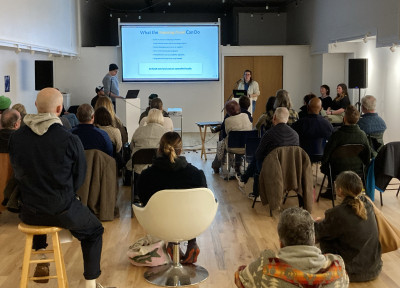
The Empty Homes Tax applies to homes that are unoccupied for more than six months. The good news for folks who don’t like taxes: If you live in your home or rent it to a tenant, you don’t have to pay a cent. The tax also includes a variety of exemptions.
Dan reminded the audience that “life happens,” and the empty homes tax is all about fairness. For example, it does not apply to vacancies due to medical care, deaths, estate transfers, renovation, military service, financial hardship, natural disasters, and a variety of other legitimate reasons. The tax is only designed to collect revenue from homes that are voluntarily kept vacant for the majority of the year. It also does not apply to short-term rentals, as the city already has a short-term rental regulatory program.
“Vacant homes are not neutral in our community,” Dan said, explaining that the high rate of vacancy negatively impacts the housing market, squeezing out residents who live and work in Astoria full time.
How much would the tax cost absentee residents? The presenters proposed a rate of $2,000 per home for the first year that the home is vacant and $4,000 for each subsequent year. This rate is similar to what other communities, like Vancouver, British Columbia and Berkely, California have done. However, it won’t be set in stone until the ballot measure is published, and they welcomed audience feedback on this rate.
Critically, the tax does more than just collect revenue. It will also incentivize some absentee homeowners to sell or rent their property long-term, creating more local housing in the short term. Not only will the tax fund the construction of new homes, but it will also allow full-time residents to access some of the homes that are already there.
Part 2: The Community Housing Fund
Tiffany Sanford added more detail about, as she called it, “the fun part,” the Community Housing Fund.
The Community Housing Fund would provide dedicated funding for a variety of clearly-defined purposes, including new construction, preservation of existing homes, infrastructure development, rental and move-in assistance, first-time homebuyer support, and eviction prevention. The fund can also be used to scale up city staff capacity so they can effectively manage and allocate the fund.
Tiffany describes how the ballot measure outlines clear standards for the use of funds, and requires the city to deliver transparent yearly reporting on the amount of money collected and what it’s used for. “It’s not a blank check for city hall,” she said. The fund is designed to be fair and consistent, with accountability to the goals set out by the community.
But how would the process actually work? If the measure passes, residents would fill out a form every year in which they mark whether or not their home is occupied. If the owner lives in or long-term rents out the home for at least six months, they simply report that their home is occupied, and do not have to pay the tax. Tiffany emphasized the fact that, “For most residents, this will be boring—and that’s intentional.”
For those who choose to leave their home unoccupied for the majority of the year, they must report this to the city and pay the tax. Self-reported homes are verified by analyzing water usage and other utility data, and there is a built-in accountability process to incentivize truthfulness. However, the presenters emphasized that this measure is not meant to be punitive, and it doesn’t ban second homes.
“Local residents already support Astoria by living and working here,” said Tiffany. “This ensures absentee owners help offset the impact of their vacant properties on the community.”
Tiffany shared her experience as an early childhood educator and autism consultant. She has lived in Astoria for the last five years and has seen the impact of the rapidly-increasing costs of housing on her students and their families, including a number of families with high-support needs children who were forced to move away from their extended family, school community, and other critical support networks.
Teresa Barnes shared a different perspective on the housing situation. She’s lived in the city since 2002, a time when working-class artists, musicians, entrepreneurs, and service workers could afford to live and thrive. These are the people that have made Astoria an incredibly special and vibrant place that draws tourists from all over the world. Now, it's time to use policy to ensure this culture does not get priced out. She celebrated the Astoria Housing Initiative as a way to “build on the city’s creative, working-class past in a way that makes sense for the future.”
Teresa emphasized: “This is not a state mandate. This is a local solution to a local problem.”
And having a local funding source for housing and infrastructure may be more important now than ever, given the degree of uncertainty with federal and state funding. For example, in 2025, the Oregon legislature cut homelessness prevention funds by 74% and the federal government cut funding for long-term housing programs by more than half.
The Impact
The work of Astoria Housing for All is far from done. To get the initiative on the ballot, they need to collect around 1,100 signatures from local residents. Astorians can support by signing and/or volunteering for the signature collection effort. Once the required number of signatures is reached, it's up to the voters to choose.
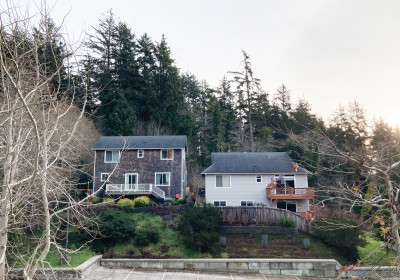
During the Q and A portion of the evening, one resident raised his hand, saying, “I love everything about this. I live across the street from a house that has been vacant for 8 years. It’s heartbreaking to see an empty house when we have so many unhoused neighbors.”
Indeed, Clatsop County has the highest per capita rate of homelessness anywhere in the state, nearly triple the rate of Multnomah County.
Other residents felt the proposed tax doesn’t go far enough to fully address the crisis they’re dealing with. Andy Kipp, the founder of the group, agreed, saying that there is no single policy that will solve all the problems, but this is a strong place to start. For example, everyone wants to rehabilitate homes that are falling down and uninhabitable. While the tax does not directly address this problem (uninhabitable homes are not subject to the tax), the Community Housing Fund could be used to renovate decaying homes and bring new life to these neighborhoods.
Another resident, Charles, shared his experience regarding the challenges of running a grassroots campaign that meaningfully challenges status quo power.
“We had folks from [out of town] just attacking us in all directions,” Charles said. “They have a lot of money and they will spend a lot of money sowing lies and distrust. You’re going to be in a campaign to tell the truth against willful liars.”
But Astoria Housing For All knows full well the kind of people that they’re up against, and they’re committed to running a truthful campaign that fights for the benefit of their community.
“We have to come together and say this is something that we as a community have decided to do, and we’re not going to buy into the lies,” said Andy. “I’m a strong believer that we can do it and we will do it, as long as this community says we will.”
One resident in attendance said, “They’ve done a lot of thinking (on the initiative), and it shows. It’s not going to fix everything, but it adds a little local stability.”
In these difficult times, a little local stability is something to celebrate indeed. There are a few other cities who have enacted similar measures: Berkeley, California and Vancouver, B.C. are the two notable examples.
If Astoria’s initiative passes, it may set a precedent for other cities in Oregon whose housing markets are heavily impacted by tourism and second home ownership. Many cities are looking for creative ways to fund housing and infrastructure, and this could be a promising tool in cities’ toolkits.
Empty home taxes may not be a good fit for every community, but there are plenty of other options to improve local housing availability and affordability. 1000 Friends of Oregon recently launched the Housing Solutions Center, which provides information and resources to advocates and policymakers looking for options to make their community stronger.
“Astoria is Astoria because of the people who make it what it is, and those people are suffering,” said Andy. “And if you love Astoria to the point where you own your second home, or third home, or fourth home here, then this fund is really about taking care of the place you love.”
Now it’s our turn to show up and support the people of Astoria: You can take a look at their website or follow @AstoriaHousingForAll on social media for ongoing updates and ways to support their campaign.