
By Sofia Baum and Jenni Denekas | 5-minute read
This Oregon Wine Month and Wildfire Awareness Month, 1000 Friends of Oregon is proud to feature Winter’s Hill Estate, a Yamhill County vineyard where three generations of the Winter and Gladhart family have built a legacy rooted in care for the land and a deep sense of responsibility for its future. They are also navigating an era of increased wildfire frequency and intensity with thoughtful and innovative approaches—creating hope for the future of Oregon wine.
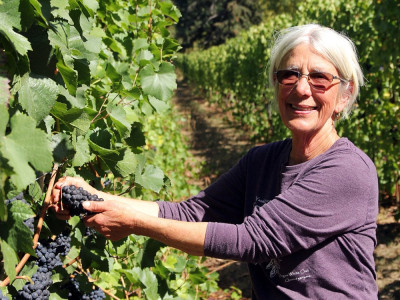
A family legacy rooted in love for Oregon’s lands
The Winter’s Hill story began in 1961, when the land was first purchased by John and Lena Winter. The couple had enjoyed visiting Oregon for years, and decided to move to the Dundee Hills from Chicago when their children were grown.
Decades later, their daughter Emily and her husband Peter Gladhart saw the land’s potential as a vineyard and planted the first grapes in 1990. Today, their son Russell Gladhart carries that work forward as a second-generation winemaker and the third generation of his family to steward this land.
“It's a special feeling to be the third generation on this land,” Russell says. “Things like planting a tree or a vineyard can last longer than one person's life, so you feel surrounded by the work and choices made by previous generations.”
For the Gladhart family, trusting that this land will remain farmland has made it possible to invest deeply in their vineyard, their wines, and their business. Oregon’s land use system has helped protect places like the Dundee Hills from fragmentation and development, giving farmers and winemakers the confidence to plan not just for the next season, but for decades ahead.
That stability allows Winter’s Hill to focus on what matters most: Growing exceptional grapes and stewarding the land that makes it all possible.
Facing wildfire risks with innovation
Stewardship has taken on new significance in an era of increased wildfire intensity and frequency in Oregon (and throughout the American West).
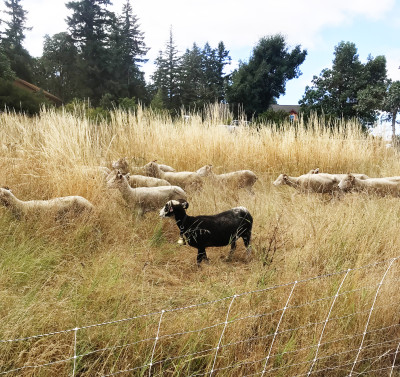
In order to mitigate fire risk, Russell has started to use goats and sheep each year to graze the oak savanna, forests, and other land near the winery and residences on the property. This helps to reduce the density of vegetation and therefore the risk of a high-intensity fire. While Winter’s Hill has been fortunate to avoid the worst wildfire impacts so far, this risk still lurks in the back of Russell’s mind.
“We have had a few small fires near our home over the years—never a real threat, but still frightening,” Russell says. “After the fires in 2020, I still get nervous any time we have a strong wind from the east, or whenever I can smell smoke.”
And the 2020 Labor Day Fires had a significant impact on Winter’s Hill in another way: Compounds from the dense smoke that blanketed the Dundee Hills during that time leached into the skins of grapes still on the vine. Winter’s Hill conducted extensive testing to determine if it would be safe to make or sell any wines that year.
“Our small business is based on our reputation for quality,” Russell explains.
Since the skins are discarded early in the making of white wines, those varieties ended up being safe to bottle and sell in 2020. It was another story for the red wines, like the Pinot noir that is emblematic of much of Yamhill County’s wine country. Creating those varieties involves keeping the skins in contact with the wine for 2–3 weeks, which is “plenty of time for those undesirable compounds to be released into the wine,” according to Russell.
“After tasting and lab analysis, we decided that the red wine was too compromised to bottle,” Russell says. “This was a major economic hit for a small winery.”
Not unlike the patchwork burn pattern created by some wildfires, some wine-growing areas were heavily impacted in 2020, while others were spared the negative impacts of wildfire smoke.
“I don't want to throw shade on other wineries who made different choices than we did,” Russell explains. “The effect of the smoke varied greatly between different vineyard locations, and many Oregon wineries made great wine in 2020.”
Stewardship as a way of life
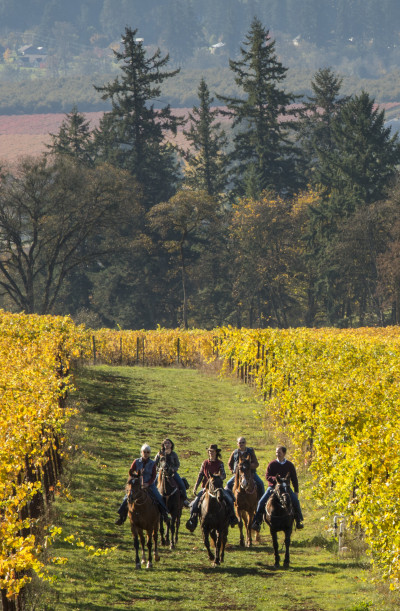
While land stewardship can feel more urgent these days, Winter’s Hill has been weaving sustainable practices into their daily operations for years.
In addition to preserving stands of Douglas fir and Oregon white oak, the Gladhart family has collaborated with the Oregon Department of Fish and Wildlife and Yamhill County Soil and Water Conservation Department to carefully restore Oregon white oak savanna and Willamette Valley prairie on their property. These two ecosystem types used to be abundant in the region and are slowly regaining portions of their historic range thanks to concerted local efforts—like the Gladhart family’s.
The Gladharts’ work on restoring wildlife habitat has earned recognition, including their inclusion in the Willamette Valley Birding Trail and being certified Salmon-Safe and LIVE since 1999, according to their website.
The Winter’s Hill winery was also designed with stewardship in mind. The unique way in which it was built enhances efficiency—including its two-level construction that utilizes gravity to transport grapes. The design also reduces energy usage and enhances temperature control with a combination of thick walls and the fact that it is embedded in the hillside.
When the wine is complete, reusable bottles and lightweight wine pouches help reduce fuel usage and carbon emissions as it is transported beyond the vineyard. These innovative measures further the longstanding focus on sustainability at Winter’s Hill.
“There is a lot of work, and sometimes pressure, to maintain what has been built over the years,” Russell says. “There is also great satisfaction to see the land in good condition, ready for the next generation to implement their dreams and ideas.”
The connection between Winter’s Hill and 1000 Friends of Oregon is rooted in these shared values. As Russell says, “We support the work that 1000 Friends is doing to protect farmland for future generations.”
The feeling is mutual: We are proud to feature Winter’s Hill as a 1000 Friends business partner, to celebrate the Gladharts’ decades-long membership at 1000 Friends, and to share their enduring vision of stewardship as they continue to innovate and adapt in a changing landscape.
Feeling inspired? We invite you to explore the ways in which we can collaborate; we welcome partnerships with businesses and other organizations whose values align with our mission.
Learn more about business partnerships