With the right planning and advocacy, we can create durable solutions for Oregon’s communities
By Mary Kyle McCurdy | 6-minute read
As you have likely noticed, Oregon is in the middle of a historic wildfire season. We have already exceeded the state’s record for the number of acres burned—over two million. Many structures have been lost, thousands of people have been evacuated, major roads and highways have been closed, wildlife and livestock have been displaced, and one firefighter has lost his life. For a time, the Akawa Butte fire near Sisters was the top-priority fire in the United States. Last Wednesday, Portland had the worst air quality of any major city in the world.
Let’s continue supporting wildfire-impacted communities
Before we get deeper into today’s topic, wildfire smoke, we want to share gratitude. Many wildfire-impacted communities have seen an outpouring of support from Oregonians across the state (and beyond). Thank you for your support for the Confederated Tribes of the Warm Springs Reservation of Oregon (CTWS), and organizations supporting farmworkers and wildland firefighters. Since wildfire recovery is a long process, we hope that, in true Oregon spirit, we can keep the support going. We have updated last week’s Wildfire Wednesday article, Supporting communities impacted by wildfire, to reflect the best ways to help at this moment.
Sharing gratitude for firefighting crews—and how to support their safety and success
We also want to share gratitude for those who are putting their health and lives on the line to reach and put out fires while they are still small, to contain them if they grow, and to protect homes, communities, and significant natural areas. Thousands of trained wildland and structural fire fighters from Oregon, across the country, and the world are spread out across our state right now, carrying out the multitude of complex tasks, including adapting in the moment to varying terrain and weather, to protect our communities and environment. They are supported by just as many in logistics and food crews, and also by those who live in these areas and make their livelihoods from the land—ranchers, farmers, small foresters.
All of us owe it to the professional and volunteer fire fighters and support crews, and to the landscape and wildlife we love, to do our part: If building or remodeling a structure, meet the wildfire resilient building code standards; create and maintain defensible space around one’s homes; ensure the eaves and other spaces into your home are closed to embers; and refrain from building homes in the wildland-urban interface that do not need to be there.
The impacts of wildfire smoke on communities
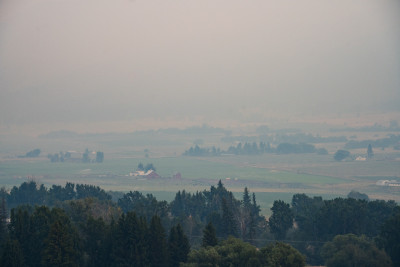
While many communities in Oregon are directly experiencing fire, even more are experiencing wildfire smoke, which spreads much farther than fire itself. Oregonians experience wildfire smoke from not only our local wildfires, but also from fires across the Western US and Canada. Wildfire smoke can cause significant health problems, especially for those who experience long-term exposure or have underlying vulnerabilities.
Symptoms can include watery or dry eyes, cough, irritated sinuses, headaches, shortness of breath, asthma, and heart conditions. A recent study concluded that wildfire smoke is now the primary pollutant affecting pregnancy, offsetting gains made in reducing other forms of air pollution. Possible adverse impacts include contributing to low birth weight and preterm births, which was found to be “disproportionately burdening low-income, rural, and Indigenous communities.”
Wildfire smoke generally contains a mixture of gases and fine particles from burning trees and other plant material. If the fire also burns through homes, other structures, or communities, it is likely to also include varying levels of toxic and hazardous materials that are released from burning household goods, which often are made of synthetic materials.
Many of us are familiar with this color-coded Air Quality Index (AQI), which was developed by the EPA and comes automatically downloaded on many smart phones.
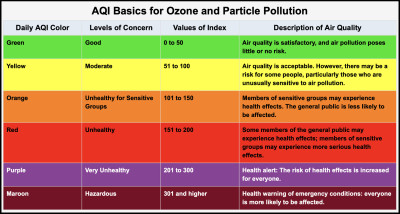
As shown in this chart, the pollutant of most concern in wildfire smoke in Oregon is particulate matter, which comes from burning trees and plants. The health impacts vary based on particle size. The tiniest—2.5 micrometers or less in diameter (PM 2.5)—are most damaging to human lungs because their small size enables deeper penetration. Those especially at risk from wildfire smoke include:
- People with asthma or other chronic respiratory disease,
- People with cardiovascular disease,
- People 65 years of age and older,
- Infants and children,
- Pregnant women, and
- People who smoke.
In addition, people of any age who work outdoors and experience long-term exposure to wildfire smoke—such as farm workers and construction workers—face serious health risks. And of course, fire fighters and the support crews are exposed not only to particulate matter, but also to carbon monoxide because of their proximity to the actual fires.
Mitigating the risks posed by wildfire smoke
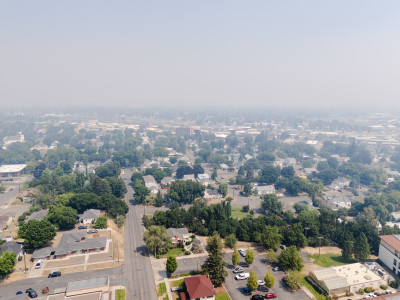
Each wildfire season, wildfire smoke impacts communities throughout Oregon for days and weeks at a time. The frequency and unpredictability of wildfire smoke means agencies and communities need to be prepared to respond quickly to smoke impacts.
When the state legislature established Oregon's comprehensive wildfire program by passing Senate Bill 762 in 2021 (and in subsequent legislation), it directed several state agencies to take certain steps to proactively help communities mitigate the health impact of wildfire smoke. The results include increased air quality monitoring, community planning to prepare for and respond to wildfire smoke, increased capacity to provide emergency sheltering in public spaces, and resources to help individuals and families safely shelter at home during smoke and extreme temperature events.
The Oregon Department of Environmental Quality (DEQ) monitors air quality across the state for various pollutants and reasons, including wildfire, and issues advisories due to wildfire smoke, so Oregonians can take steps to protect their health. DEQ’s maps and charts tracking wildfire smoke pollution levels by regions throughout Oregon and in specific communities show the increasing number of days with air quality rated as unhealthy or worse.
The Oregon Health Authority (OHA) has an informative fact sheet to help Oregonians know what to do when they are experiencing, or might experience, health impacts from wildfire smoke. OHA distributed approximately 10,0000 residential smoke filtration devices in six of the highest wildfire-prone counties.
However, much of this has been accomplished through one-time funding from the legislature. There is widespread demand by communities for funding to develop and maintain community response plans (CRP) for smoke, for additional air filtration systems for homes and institutions, for more air quality monitors, and for more public education about wildfire smoke To continue the good work started by these agencies and spread it wider will require durable funding from the state.
All Oregon communities should have access to the tools and services that will help them to thrive in the long-term—and Oregon’s land use program provides critical tools to achieve this. Together, we can advocate for a healthier and more prosperous future.
Wildfire Wednesday is a weekly storytelling project that aims to increase wildfire resilience across Oregon.
See all Wildfire Wednesday content here