
By Eve Goldman | 4-minute read
A case that has the potential to set a significant precedent for farmland protections continues (we shared an update about this last year). Now, Friends of Yamhill County, represented in the most recent appeal by Crag Law Center, have attained another key victory in this ongoing saga, which continues to strengthen Oregon’s legal protections for keeping luxury hotel development off farm land.
On August 13, 2026, the Land Use Board of Appeals (LUBA) remanded an application in Yamhill County for a conditional use permit (CUP) to operate a bed and breakfast facility as a home occupation in a farm dwelling on exclusive farm use (EFU) zoned land. The purported “dwelling” is owned and operated by the Foley Entertainment Group, LLC, a hospitality and entertainment company that manages a variety of luxury hotels and entertainment venues around the world.
The question at issue was whether the home occupation will be located within a dwelling allowed in the EFU zone, in this case a “farm dwelling” under OAR 660-033-0135(4). LUBA concluded that the applicant failed to demonstrate that the proposed met the requirements of a “farm dwelling,” including that the structure be the home of the farm operator (Friends of Yamhill County v. Yamhill County (Grange Hill IV); LUBA No. 2026-016, Aug. 13, 2026; slip op at 38). LUBA determined that the most straightforward and legally sufficient means to determine whether the proposed resident of a home occupation in a farm dwelling is the "farm operator" for that farm operation is to determine whether that person would qualify under OAR 660-033-0135(4)(a) or (c). Id. (slip op at 39).
This was Yamhill County’s second attempt to approve this CUP. The County’s first attempt was initially approved by LUBA, who concluded that the structure met the definition of a “dwelling” according to relevant case law and state policy protecting agricultural land (Friends of Yamhill County v. Yamhill County (Grange Hill I); LUBA No. 2022-081, Dec. 27, 2022; slip op at 16). LUBA’s decision was then appealed by Friends of Yamhill County (FYC) to the Court of Appeals who reversed LUBA’s decision in 2023, concluding that the proposed structure was not a “dwelling” at all but a motel (Friends of Yamhill County v. Yamhill County (Grange Hill II); 325 Or App 282, 2023).
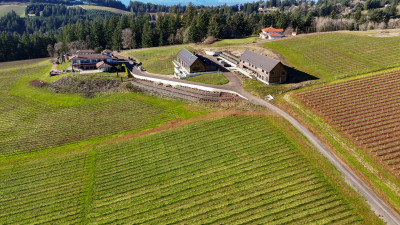
The Supreme Court granted review of the Court of Appeals’ decision. This 2025 review partly affirmed the court’s decision and partly reversed it (Friends of Yamhill County v. Yamhill County (Grange Hill III); 373 Or 790, 2025). Notably, the Supreme Court concluded that the applicant had failed to demonstrate that the structure was the home of a farm operator, and remanded the decision to LUBA to determine, de novo, whether the structure met the local code requirements for a single family dwelling or a hotel. LUBA then remanded the decision for the County to address both the “farm operator” and “design characteristics” issues (Friends of Yamhill County v. Yamhill County (Remand Order); LUBA No. 2022-081, Sept. 19, 2025; slip op at 10, 11).
Now for the second time, LUBA has remanded the case back to Yamhill County with the instructions that the applicant demonstrates that the home occupation will be located in a dwelling allowed in the EFU zone, in this case a “farm dwelling” under OAR 660-033-0135(4). To qualify as a farm dwelling, LUBA concluded that the county must identify the farm operator using the two relevant qualifications outlined in OAR 660-003-0135(4) ((Grange Hill IV); slip op at 38, 39). First, under OAR 660-033-0135(4)(a), a qualifying farm operator must earn "at least $80,000 in gross annual income from the sale of farm products in each of the last two years or three of the last five years, or in an average of three of the last five years." Second, the applicant for a farm dwelling must show that the dwelling "will be occupied by a person or persons who produced the commodities that grossed the income in [OAR 660-033-0135(4)(a)]."
LUBA also concluded that remand is required for the County to conduct the appropriate inquiry under the home occupation statute (ORS 215.448) and to adopt adequate findings addressing all relevant design characteristics to support a conclusion that on balance the structure should be primarily categorized as a dwelling or transient lodging not allowed in the EFU zone (Id.; slip op at 18, 19, 23).
"This decision supports our ongoing efforts to protect Yamhill County's irreplaceable farmland from inappropriate non-farm development," said FYC vice president Anneka Miller. "The Supreme Court, and now LUBA, decisions clarify and limit the circumstances under which overnight lodging may be permitted in people's homes."