
Transit-oriented development is a smart-growth strategy that can help Oregon meet its housing needs while also contributing to its climate targets
By Jackson Schroeder | 8.5-minute read
While Oregon is slowly making progress towards ending its housing shortage, it is still far behind on its climate targets. A statewide transit-oriented development zoning bill could help address both these issues—while also reducing displacement.
Oregon has a 20-year housing need of 491,347 units, according to the latest production targets report from the Oregon Department of Administrative Services (DAS) for the Oregon Housing Needs Analysis (OHNA) program. Oregon’s housing need is disproportionately concentrated in accessible and affordable housing. While 7% of Oregon households earn less than 30% of the area median income, they represent 20% of the state’s 20-year housing need. Similarly, 7% of the population has difficulty walking, but only about 0.3% of Oregon’s housing units are fully accessible for wheelchair users.
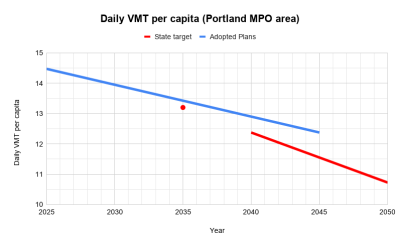
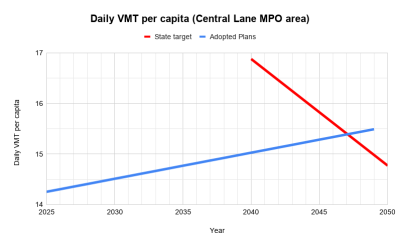
Just as Oregon sets housing production targets through OHNA, it also sets targets to reduce its climate impact. To reduce emissions from the transportation sector, the Land Conservation and Development Commission (LCDC) adopted the metropolitan greenhouse gas (GHG) reduction target rules in 2011. These targets extend until 2050 and are measured in daily light-duty vehicle miles traveled (VMT) per capita, relative to 2005 levels. To comply with this rule, metropolitan planning organizations (MPOs) project VMT in their regional transportation plans. Unfortunately, two of Oregon’s largest metro areas—Portland and Eugene—project that, with currently adopted plans, they are off-track from the state’s VMT reduction targets.
On a statewide level, Oregon has a 2020 executive order to reduce GHGs from transportation by at least 80% from 1990 to 2050. This equals 4.2 million metric tons of CO2 equivalent (Mt CO2e) of GHGs in 2050. But despite the dedicated efforts of state agencies to meet this target, ODOT predicted in September 2026 that with currently adopted plans, Oregon’s 2050 transportation emissions will be 16.81 Mt CO2e—about four times where it should be.
Transit-oriented development (TOD) is a smart-growth strategy that can help Oregon meet its housing needs while also contributing to its climate targets. TOD is not new to Oregon: The 1991 Transportation Planning Rule (OAR 660-12) requires cities to allow TOD, but doesn’t quantitatively define TOD (such as minimum density allowances), and thus is more of a suggestion for cities.
Metro, the regional government for the Portland area, established its TOD program in 1998, which has since helped build over 6,800 housing units near transit, primarily through grants to developers. Since TriMet formally established its TOD program in 2015, it has helped build 718 units, primarily through land banking near transit. These TODs significantly increase transit ridership while providing affordable housing, but they are illegal in many parts of Oregon due to zoning restrictions. State legislators attempted to allow more TODs with bills in 2019 and 2021, but neither passed, partially because some local governments expressed concerns that the bills would upend local planning efforts.
However, several recent developments in the political landscape would make a TOD bill much more efficient for cities to implement:
- Cities have become more familiar with the requirement to complete a Housing Production Strategy (HPS) every several years as part of OHNA. The TOD bill could include TOD zoning as an action in the HPS of relevant cities, so it better integrates with their existing planning efforts, instead of upending them.
- To help cities design their HPS, LCDC adopted housing model codes in 2025, which include multi-unit siting standards. These standards clarify how to zone for buildings that generally go up to five stories: Exactly the type of housing that works near transit. The TOD bill could utilize these multi-unit siting standards, which then allows city planners to work with zoning codes they’re already familiar with. This also enables developers to design one building that works in multiple cities, and even pre-fabricate them. Additionally, the generous FAR bonuses for accessibility and affordability can help address those critical aspects of Oregon’s housing shortage.
- The Senate Housing Committee is currently led by a bipartisan duo, Senator Pham and Senator Dick Anderson (R-5), who understand that current residential zoning does not allow the diversity of densities and housing types to meet the needs of all Oregonians.
- Finally, in the past seven years, five states have passed TOD bills: Massachusetts, Colorado, Washington, California, and Maryland. Multiple California cities saw historically high permit applications for multi-unit housing in the first month that the bill took effect. This demonstrates that when TOD bills are written carefully, they can be popular with cities, residents, and developers. Furthermore, Oregon can learn from other states’ implementation, such as California’s “TOD alternative plans” where cities can reallocate zoned capacity to where it works best for them.
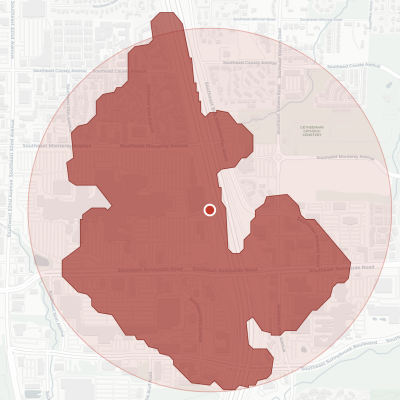
There are two additional ways a 2027 TOD bill could improve on previous attempts. First, it could rezone lots near transit according to walking distance, not as-the-crow-flies. This would prevent rezoning lots that aren’t actually a short walk from transit (because they’re across an interstate or other pedestrian barrier). Second, instead of applying to all frequent bus stops, the TOD bill could apply to the intersections of two or more frequent bus stops (just about 5% of lots in the Portland metro area), which are less likely to have service cuts.
To take advantage of these factors, 1000 Friends is working with Senator Khanh Pham (D-23)’s office to develop a legislative concept for a 2027 TOD bill. The legislative concept will continue to evolve with feedback from cities, legislators, and other advocates.
So, how can state legislators and advocates make sure that bill has the best outcome for residents and local governments? To answer questions like this, researchers often model the potential impacts of a bill. Accordingly, I defined a hypothetical TOD bill that would require cities to zone residential lots near transit to be no more restrictive than the multi-unit siting standards.
“Lots near transit” means all lots that are any of the following:
- Within a 10-minute walk of light rail stations.
- Within a 5-minute walk of existing or currently planned bus rapid transit stops, commuter rail stations, or streetcar stops.
- In the Portland metro area only, within a 5-minute walk of the intersection of two or more frequent bus lines.
This means the hypothetical bill would apply to the Portland and Eugene-Springfield metro areas. To model the impacts of the bill, I wrote a program that includes two development scenarios: Adopted Plans and TOD. While it is difficult to predict total housing production, because it depends on volatile factors such as economics and immigration, I decided to cap each region’s housing production at its 20-year housing need.
To predict the number of units developed on each lot, I fit a curve to the relationship between land value per square foot and density, which are strongly correlated because if land is more expensive per square foot, developers have to put more units on it to make a profit. This approach ensured that every projected development in my model was financially realistic for developers. Additionally, because upzoning often increases land value, the TOD bill caused lots near transit to develop denser than they would have otherwise, and thus fewer total lots were developed to meet the same housing need. I was then able to determine the percentage of units in each metro area near transit, which allowed me to calculate the climate benefits of the bill—specifically, each region’s reduction in daily VMT per capita due to transit access.
With a robust TOD bill, Oregon doesn’t have to choose between meeting its housing targets or climate targets: It can do both, while displacing fewer residents and building stronger communities.
My model does not predict one set of impacts, but rather predicts a realistic combination of impacts given a set of assumptions about developer preferences in response to the housing market. In other words, this can help predict if a developer would rather buy a cheap, vacant lot or a more expensive (but more profitable) lot with a building on it.
The Portland MPO area needs about 178,000 net new housing units by 2045. To meet that target, developers could likely demolish 3,100 units in the Adopted Plans scenario. With a TOD bill, those same developers, with the same priorities, would demolish only about 1,700 units—that’s 1,400 families that would no longer be displaced!—while building 12,500 units near transit that would not have been there without the bill. This would modestly reduce daily VMT per capita from 12.38 to 12.34 in 2045—still above that year’s target of 11.6.
The Central Lane MPO area needs about 33,000 net new housing units by 2045. Assuming a modest demolition rate of 500 units in the next 20 years, the bill would reduce the demolition of a couple dozen homes while helping build around 300 units near the EmX that would have not been financially feasible to build in the Adopted Plans scenario.
The bill would reduce statewide greenhouse gas emissions by about 12,000 metric tons of CO2e per year by 2045. This is a significant amount, but is just about 0.1% of Oregon’s projected total transportation emissions that year. This marginal impact is partially due to projected advancements in clean vehicle technology, so each vehicle mile emits less GHGs anyway.
My development model is much simpler than the pro forma models that local governments typically use—which better predict developer behavior based on factors such as local rents and demolition costs. Nevertheless, my model shows that if Oregon simply sets the table for TOD, it could see the aforementioned benefits of the bill due to market forces alone. Oregon could amplify these benefits with TOD development incentives, such as Metro’s TOD grants, or fast-tracking the TOD permitting process. With a robust TOD bill, Oregon doesn’t have to choose between meeting its housing targets or climate targets: It can do both, while displacing fewer residents and building stronger communities.
Further reading
- Check out our profile on Jackson
- Learn more about our Gerhardt Internship program
- Learn more about our Great Communities program