
The Wildfire Prepared standards of the Insurance Institute for Business and Home Safety can provide a useful framework for keeping Oregon’s communities safer
By Mary Kyle McCurdy | 5-minute read
Check out our weekly Wildfire Wednesday newsletter (sign up here) and website updates, and check out our biweekly #WildfireWednesday content on Facebook, Instagram, and LinkedIn. We also would love to hear and amplify your stories; please email us with your ideas!
Oregonians are motivated to make their homes and communities more wildfire prepared and resilient for many reasons, including safety and living more sustainably within the natural environment. Another consideration is maintaining insurance for their homes or business properties, and at a relatively affordable level.
That’s what we’re diving into this Wildfire Wednesday, and that’s where the Wildfire Prepared standards of the Insurance Institute for Business and Home Safety (IBHS) can come in.
The IBHS is a nonprofit scientific research organization supported by property insurers, reinsurers, and affiliated companies. It uses research, testing at scale, and post-disaster investigations to evaluate materials and systems to keep homes and businesses safer in the face of wildfire, hurricanes, tornadoes, hail, and more.
IBHS has developed the Wildfire Prepared program, which provides a roadmap for reducing wildfire risk in 14 states for homeowners, neighborhoods, business property owners, builders, developers, and multifamily property owners. The multifamily guidance covers duplexes, townhomes, apartments, and condominiums. The IBHS science and experience based standards demonstrate that making sure your home or individual property is wildfire resilient is just the first step. One’s community must also be resilient to truly reduce wildfire risk.
Using the IBHS Wildfire Prepared Home standard, homeowners can “earn a designation by completing a set of science-based actions addressing three vulnerable areas of a home—the roof, specific building features and defensible space—to meaningfully reduce their home’s wildfire risk.” IBHS provides a homeowner’s guide, with an easy-to-follow checklist. This checklist is consistent with Oregon's currently voluntary wildfire building code and the defensible space code. Note, however, that Oregon's wildfire—or “home hardening”—building code applies only to single homes and two attached homes, while the IBHS has guidelines for more dense housing types as well.
Many recommendations require ongoing maintenance—such as ensuring that the first five feet around a home are free from combustible vegetation and structures, and removing vegetative debris from roof, gutters, and downspouts. Therefore, once the initial “Wildfire Prepared Home” status is achieved, property owners must demonstrate maintenance of it for three years. In an upcoming Wildfire Wednesday article, we will feature the first home in Oregon that has been certified as meeting the IBHS Wildfire Prepared standard.
Oregon has the unique opportunity to be a proving ground for the IBHS Wildfire Prepared Standard and whether taking these steps to reduce wildfire risk can make a meaningful difference for insurance coverage and rates for Oregonians. The foundation for this is already set: In May 2025, the Oregon State Fire Marshal and IBHS signed a Memorandum of Understanding (MOU) to partner on ways to build the IBHS wildfire standards into Oregon buildings and communities. This has the potential to not only keep our communities safer, but also to help support stabilizing insurance availability and rates.
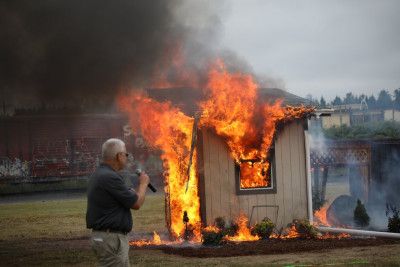
In June 2025, the OSFM and IBHS partnered to burn (or try to burn) two small model homes situated next to one another. One home—built with conventional materials and landscaping—burned down quickly. The other home was built to the IBHS Wildfire Prepared Home standard, using defensible space best practices and non-flammable materials. It did not burn down. This comparison burn demonstrates the effectiveness of using wildfire resilient building material and defensible space and emphasizes a key lesson of our Wildfire Wednesday series: It is much less expensive for the property owner and for all Oregonians to invest upfront in reducing risk, rather than pay the cost of firefighting and recovery afterwards.
For Oregon to succeed in both reducing community wildfire risk and keeping insurance stable, we need widespread implementation of the IBHS standards, especially in the state’s wildland urban interface (WUI) areas. While Oregon's “home hardening” building code and defensible space standards have been established at the state level, currently they are only voluntary. The local governments that have voluntarily adopted building and community risk reduction standards include Ashland, Sisters, Deschutes County, Grants Pass, and Medford. But overall, statewide implementation is patchy and it will take a long time to achieve a meaningful degree of risk reduction at scale as long as this remains optional.
The IBHS collaborated with the National Fire Protection Association (NFPA) and Verisk, an insurance data analytics company, to examine community vulnerability and wildfire readiness in and around the WUI at the state and county level in the western US. They published their findings in Living with Wildfire. The report observed that:
“Few states and counties with the greatest risk of wildfire disasters are using sound regulatory approaches backed up by consistent enforcement. Outside of California and Utah, there are no enforced, statewide codes addressing wildfire exposures to residential and commercial property; code use and enforcement at the local level remains limited.”
The IBHS Living with Fire report recommends that states “use[e] and enforc[e] the most recent model WUI codes for new residential and commercial construction” and “requir[e] frequent updates of community wildfire mitigation plans.” We agree: All new residential construction and significant remodels in Oregon should meet the state’s “home hardening” wildfire code. We have the opportunity to get ahead of what will undoubtedly be required by insurance companies in the near future.
It’s also the only way to ensure that all Oregonians, including some of our most vulnerable neighbors, share in the benefits of wildfire risk reduction. Approximately one-third of all Oregonians rent their homes, so achieving meaningful results will generally require landlords to implement these sensible and safe practices. It also means that use of wildfire resilient building materials should be built into affordable housing funding formulas and requirements.
Enforceable state standards for building materials and defensible space is the surest and most efficient way to reduce wildfire risk, move towards a wildfire resilient Oregon, and maintain a stable, relatively affordable insurance market.
Next Wildfire Wednesday: Reducing wildfire risk is an economic development strategy—and necessity.
See all Wildfire Wednesday content here