
390,000 Oregonians and counting live in wildfire-prone areas. Everyone in the state pays the price
By Ricardo Pelai, Sightline Institute
This article is a special Wildfire Wednesday feature by our partners at Sightline Institute, highlighting the risk and costs of wildfires across of the entire Northwest region from a report published earlier this year. This article is also published here.
Check out our weekly Wildfire Wednesday newsletter (sign up here) and website updates, and check out our biweekly #WildfireWednesday content on Facebook, Instagram, and LinkedIn. We also would love to hear and amplify your stories; please email us with your ideas!
Takeaways:
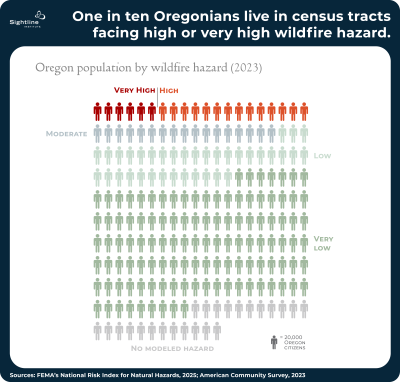
- Nearly 390,000 Oregonians, about one in ten people, live in census tracts with high or very high wildfire hazard, and more than 20,000 people moved into fire country between 2018 and 2023.
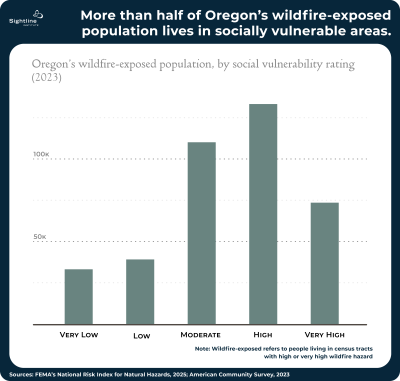
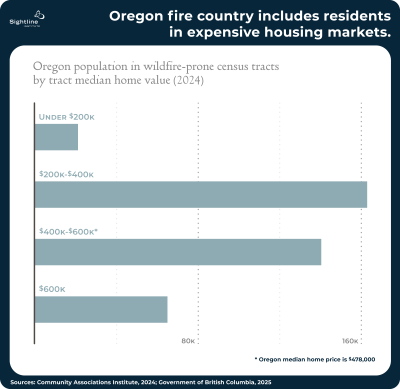
- Wildfires affect both vulnerable and affluent communities. More than half of Oregonians living in fire country also live in socially vulnerable areas, while about one-third live in communities where median home values exceed the statewide median.
- As wildfire makes more homes harder to insure, growing reliance on last-resort insurance could leave residents statewide subsidizing its costs.
- Oregon leaders can rein in the growing costs of wildfires by facilitating accurate home insurance pricing, helping low-income families in high-risk areas keep coverage and protect their homes, and changing where and how communities build homes.
- Full report available here.
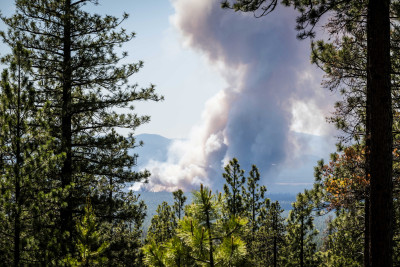
Wildfire has burned Oregon’s landscapes for millennia. But hotter, drier summers; decades of fire suppression; and continued sprawl of homes and infrastructure into parts of the state likely to burn are increasing the likelihood of deadly, costly megafires.
Many people living in Oregon’s highest-risk communities lack the resources to prepare for and recover from disaster. At the same time, other residents of fire country live in fast-growing, affluent communities that can be expensive to rebuild.
People living directly in fire’s path stand to lose the most. But increasingly, all Oregonians, no matter where they live, are paying for leaders’ choices to allow continued encroachment of buildings into fire-prone areas. Early indicators of these spreading costs show up in the state’s insurance market. As premiums rise and insurers drop coverage, more homeowners turn to last-resort insurance, and residents statewide can end up subsidizing its costs.
To mitigate the growing crisis, Oregon policymakers can facilitate accurate home insurance pricing, help low-income families in high-risk areas keep coverage and protect their homes, and change where and how communities build to improve safety.
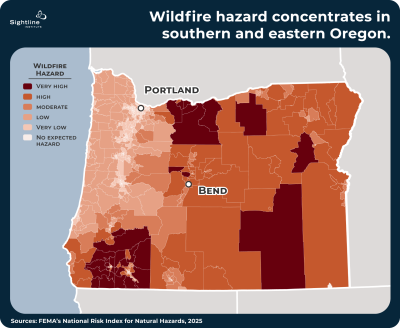
Wildfire hazard concentrates in a few Oregon counties
Most of Oregon’s high- and very-high-wildfire-hazard census tracts cluster in rural southern and eastern Oregon, according to the US Federal Emergency Management Agency (FEMA).
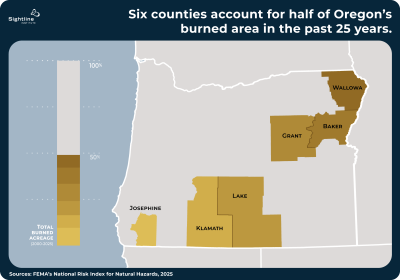
Between 2000 and 2025, half of Oregon’s burned area occurred in just six out of 36 counties: Baker, Grant, Josephine, Klamath, Lake, and Wallowa. Less than 5 percent of the state’s total population lives in these counties, underscoring how supporting a relatively small number of communities can reduce the impacts of wildfires statewide.
Still, nearly 390,000 Oregonians—about one in ten people—lived in wildfire hazard areas in 2023, and the number has been growing. More than 20,000 people moved into fire country between 2018 and 2023. In fact, some of the fastest-growing places, including the suburbs of Bend and Medford, are also among the places most likely to burn. Between 2018 and 2023, Oregon’s population of high-hazard areas increased by five percent, compared with three percent in low-hazard areas. (In absolute terms, though, most people moved into low-hazard areas.)
Wildfires affect both vulnerable and affluent Oregonians
Who lives in Oregon’s riskiest areas? More than half of Oregonians living in high-hazard census tracts also live in areas FEMA rates high on social vulnerability—places with relatively low incomes, high housing instability, and other socioeconomic disadvantages. People in these communities are more likely to face harm, displacement, or catastrophic economic loss when wildfires strike.
High-hazard Census Tract 3616.01 in Josephine County, which includes Cave Junction and parts of the Illinois Valley, shows the overlap between wildfire threat and social vulnerability. The tract’s median household income sits around $39,000, roughly half of Oregon’s statewide median, and about one in four residents live below the poverty line.
At the same time, about 20 percent of Oregonians in wildfire hazard areas live in relatively affluent communities. And, about one third of residents in high-hazard tracts live in places where the median home value exceeds Oregon’s statewide median (about $478,000 in 2024). In 2010, 80 percent of all seasonal (mostly vacation) homes in Oregon were in or adjacent to wild, flammable vegetation, where wildfire hazard tends to be high.
High-hazard Tract 6.03, on the outskirts of Bend, illustrates the fast-growing, high-cost side of fire country. The median household there earns about $124,000 a year, and the median home value approaches $742,000—both about 40 percent above Oregon’s statewide average. The population there grew by about 25 percent from 2018 to 2023.
Growing reliance on last-resort insurance is an early warning that wildfire costs may extend throughout the state
All Oregonians pay for the growing impacts of wildfires, including people in vulnerable communities far from the places most likely to burn. These costs include higher taxes for firefighting, higher energy bills as utilities fireproof infrastructure, poorer health when smoke pollutes the air hundreds of miles from the flames—and higher insurance bills.
Oregon has not yet experienced the full-blown wildfire-driven insurance crisis hitting other states, but early signs suggest the market is beginning to strain. About 1 in 147 households in Oregon lost insurance coverage from the private market in 2023, compared with 1 in 294 households in 2020. Insurance premiums are also rising; average homeowners’ insurance premiums in Oregon reached about $1,700 in 2024, up 46 percent from 2014, though still below the US average and below premiums in California, Montana, and Washington.
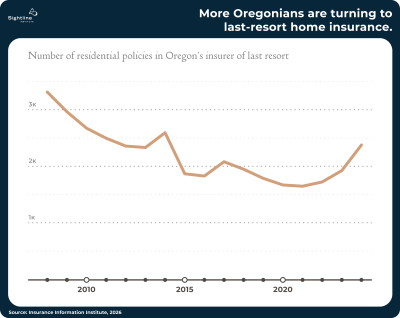
When insurers do not cover high-risk properties, more homeowners turn to state-authorized insurers of last resort, known as Fair Access to Insurance Requirements (FAIR) plans. FAIR plans tend to cover less and charge more than private insurance. When premiums for FAIR plans fall short of payouts, private insurers pass on the shortfall to all customers, no matter where they live. (Emerging evidence suggests that, even in the private insurance market, insurers selling state- and region-wide policies may subsidize high-risk areas by charging higher premiums to people living in low-risk areas.)
For low-income families in fire country, losing private insurance can mean lacking any affordable coverage options. Homeowners who cannot afford insurance may forgo coverage entirely and rely more heavily on limited public disaster relief programs.
Oregon’s FAIR Plan enrollment remains below its 2008 peak, in part because the state has maintained a relatively competitive and well-diversified private insurance market. Insurers in Oregon have been able to price risk more accurately than other states, including California. Oregon’s FAIR Plan covered about 2,400 residential policies in 2024—about 0.2 percent of Oregon’s insured homeowner households—compared with more than half a million FAIR policies in California.
But Oregon’s enrollment in FAIR plans has started to rise again since 2021, largely due to increased wildfire exposure. That uptick could be an early warning sign that more homeowners are struggling to find coverage in the private market—and that Oregon leaders can do more to steer homebuilding out of harm’s way, while protecting vulnerable communities already living in wildfire-prone areas.
Lawmakers in Oregon can rein in wildfire costs that come with continued sprawl
For starters, Oregon can avoid policies that distort insurance prices and do not reduce underlying wildfire risk. In 2023, for example, Oregon explicitly banned insurance companies from using the state’s own wildfire hazard map as a basis for denying coverage or raising rates, before repealing the map itself. Artificially low insurance rates can obscure the full cost of living in fire-prone places, encourage more growth in harm’s way, and make insurers more likely to pull back from high-risk areas. Lawmakers could allow insurers to use past claims when setting rates, which Oregon currently outlaws, while also requiring insurers to offer discounts when homeowners take verified steps to reduce wildfire risk.
At the same time, Oregon can help low-income families in high-risk areas afford coverage and protect their homes. The state could offer means-tested FAIR Plan premium subsidies and automatically qualify low-income households who are enrolled in FAIR Plans or are at risk of losing insurance, for home hardening grants.
More ambitiously, Oregon can change how and where it builds. The concentration of wildfire hazard in a few parts of Oregon means the state can focus its support and risk reduction efforts in communities with the greatest need and see outsized impact. Oregon’s urban growth boundaries already limit some development in wildfire-prone places. Lawmakers can build on those strengths by expressly preventing or minimizing sprawl into areas with the most wildfire risk and restoring the wildfire-resistant building code requirements for high-risk areas that the state repealed in 2025. They can also provide funding to help low-income families rebuild in safer locations after disasters. These reforms would spare more residents from living in the highest-risk homes, facing mounting insurance costs, or losing everything when those homes burn.
Finally, leaders can continue to address the housing shortages in low-risk parts of the state, giving Oregonians more options to put down roots safely without adding to the ballooning costs of fires.
Next Wildfire Wednesday: The Oregon Conservation Corps
See all Wildfire Wednesday content here