
Lessons from Sisters, Talent, and Ashland
By Mary Kyle McCurdy | 5-minute read
Check out our weekly Wildfire Wednesday newsletter (sign up here) and website updates, and check out our biweekly #WildfireWednesday content on Facebook, Instagram, and LinkedIn. We also would love to hear and amplify your stories; please email us with your ideas!
The increased frequency and severity of wildfire in Oregon is not just an abstract possibility. Some communities—like Talent, Phoenix, Detroit, and the Santiam area—have had to rebuild after significant wildfire damage, and many others have had to contend with wildfire-related impacts to public health.
Oregonians are facing these significant challenges with characteristic toughness and ingenuity. Here are just a few examples of well-planned wildfire recovery and resilience measures that cities around the state are taking.
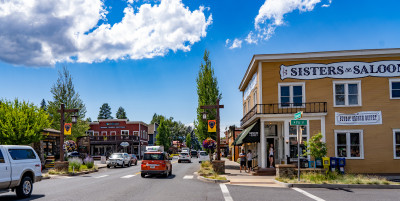
Sisters: Protecting homes through city code changes
In 2025, Sisters adopted a new city-wide development code aimed at protecting homes from being destroyed by wildfires. It requires vegetation-free space around homes, prohibits flammable vegetation within 30 feet, requires non-flammable fencing, and restricts tree branches near structures (see this piece for an overview of defensible space and home hardening).
Developments must have a city-approved Fire Prevention and Control Plan, including locational requirements for fire hydrants and truck access.
Keep an eye out for our upcoming multimedia story about Sisters!
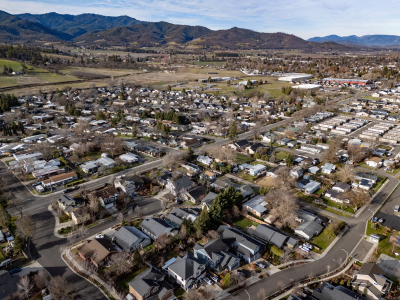
Talent: Rising from the Almeda Fire
The 2020 Almeda Fire destroyed over 2,500 homes and almost 200 businesses in Talent, Phoenix, Medford, and Ashland. Most of the homes lost were in manufactured home parks, and were owned by individuals and families with modest incomes. It also resulted in almost half the students in the Phoenix–Talent School District being displaced from their homes. Many residents worked in businesses supporting a major industry in the region—tourism.
Community leaders, the school district, elected officials, and local businesses worked hard to keep these families, students, and employees in the region during all phases of recovery and rebuilding—and they also wanted to ensure the community built back smarter. Many worked tirelessly and creatively to make this vision a reality.
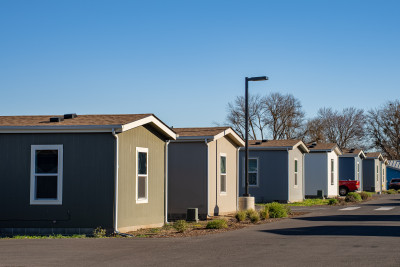
Funding from the Energy Trust of Oregon, the American Rescue Plan of 2021, the Oregon Fire Hardening grant program, the state’s Energy Efficient Wildfire Rebuilding Incentive program, and other sources, coupled with willing builders and developers, enabled incentive packages to be put together to build hundreds of energy-efficient homes that are also fire-resilient. Programs also replaced manufactured and mobile homes with ones built to new standards that meet wildfire resilience and energy efficiency. These homes are both energy-efficient and wildfire resilient, which are better for the residents and better of the community.
However, this ongoing work is facing an uncertain future due to funding changes. Several of these funding streams no longer exist, others will need to be renewed by the Oregon legislature, and others depend on nonprofit organizations for funding.
Rather than taking action only after a disaster, we should learn from the 2020 Labor Day Fires by preparing for the future: Adopting basic wildfire resilient building codes in at least the state’s wildfire-prone regions, if not statewide.

Ashland: Leading the state in proactive approaches to wildfire risk mitigation
In many ways, Ashland has been leading the state in taking proactive, meaningful, community-wide actions to reduce wildfire risk. Rather than denying reality, which some in Oregon seem to be doing, Ashland embraced it and acted.
Ashland delineated the entire city as in the wildland-urban interface (WUI) area in 2018. The city has adopted a Community Wildfire Protection Plan (CWPP), which aims to ensure that 90% of all properties in the city are compliant with the IBHS Wildfire Prepared Home standards within ten years. The CWPP recognizes that voluntary compliance is both too slow and can result in a patchwork of compliance to provide sufficient protection. Some steps are already in place, such as community-wide education, support for FireWise communities, and prohibitions on flammable plants. Others are incentives, assistance, and regulations on defensible space and building codes. Best practices for wildfire resilience will be applied to all structures, new and existing. And the city plans to provide technical and financial assistance to those who need it to comply. But these approaches have their limits, as the Ashland CWPP states:
Anecdotally, voluntary compliance works incrementally over time, with a fraction of the population, while most individuals and organizations do nothing to mitigate wildfire vulnerabilities. Codes and ordinances are enacted to provide requirements and direction to well-meaning uninformed individuals, and to those individuals who would prefer not to voluntarily comply regardless of how unsafe it may be. Using public outreach with recommendations and best practices relies on voluntary compliance, which works for individuals and organizations with a higher sense of social responsibility, whereas requirements (code) work to protect everyone, including less socially responsible individuals.
All Oregonians and communities can learn from Sisters, Talent, and Ashland by taking proactive steps now to both reduce wildfire risk and be more wildfire prepared. Acting before a wildfire (or any other disaster) to lessen its impacts saves lives, money, and communities.
Next Wildfire Wednesday: Integrating land use planning and wildfire preparedness: Transportation, part 1.
See all Wildfire Wednesday content here