
By Jacky Lee | 14.5-minute read
I met Zach Barrett in front of Dream Machine, a trendy coffee shop overlooking the rocky coastline of Yachats. Zach lives in town and works in harm reduction with clients experiencing housing insecurity. Despite working full-time, he lives with his parents and is unable to find an affordable home to rent in town.
Over the past few years, he’s left and returned to Yachats several times, in part because of not having a place of his own that he can afford. “When you don’t have your own home, it’s hard to feel like you’re a part of the community,” Zach explains.
Zach said he doesn’t know anyone in Yachats that works in town and rents on their own. He knows a group of eleven people sharing a 3-bedroom house—a common arrangement for folks with lower incomes. Many friends his age commute into Yachats from other coastal communities that are more affordable, like Waldport or Newport. Due to the lack of affordable housing, there are few other young people living in the community, and few activities for young people.
Yachats has only about 1,000 residents, but the population nearly quadruples in the summertime when “sunbirds” (summer snowbirds) and tourists come from all over to visit the world-class tidepools, eat fresh seafood, and stay in the 60% of homes that sit vacant for most of the year. Most full-time residents are retirees, and most of the service workers commute from out of town where housing is more affordable. During the winter months when tourism is low and shops close up, many workers have to file for unemployment.
An opportunity to diversify housing types
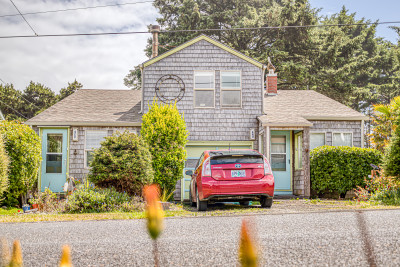
Currently, the city is considering some changes to their development code that would re-legalize certain types of small homes, including accessory dwelling units (ADUs), duplexes, cottage clusters, and others. It would also allow property owners to split existing single detached homes into duplexes or other multiplexes, known as a middle housing conversion. The goal is to improve availability and affordability of housing, especially for working families and younger people.
The legislature already required these changes for larger cities, but Yachats is exempt because of its small size. However, small cities are still allowed and encouraged to voluntarily adopt middle housing laws—a good first step towards improving affordability.
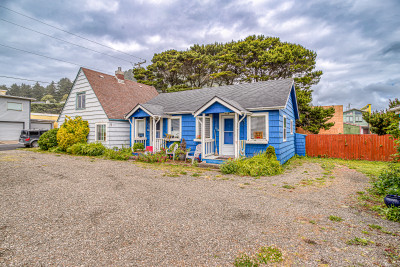
Yachats already has a number of duplexes, ADUs, cottages, and other middle housing types that were built when these were still widely legal and practical to build. Many of these homes are exactly what gives Yachats its small-town aesthetic, which makes residents and visitors fall in love with the area in the first place. Unfortunately, for the last few decades, only single-detached houses—generally, the most expensive and land-intensive housing type—have been permitted and built.
On June 16, the planning commission met to discuss the proposed changes. During the meeting, a wide variety of opinions were shared. Some favored the zoning changes, citing the intense need for more attainable and affordable homes for working families and full-time residents. They also explained that businesses need a consistent worker and customer base that is not tied to seasonal tourism.
“It will change the vibe, but that’s not a bad thing. Yachats has already changed, and it's going to continue to change. I prefer to look at this as a change toward progress.”
—Zach Barrett
Additionally, with an aging population, it’s important to allow homeowners the flexibility to change and adapt their physical and financial assets as their needs change. According to the Centers for Disease Control (CDC), around 40% of adults over the age of 65 have a disability and 25% have difficulty walking or climbing stairs.
In cities where middle housing is legal, ADUs and other conversions provide people with more options to adapt to these challenges. Some older adults choose to split their home into a duplex—for instance, living only on the bottom floor and renting out the top. Others choose to build an ADU to house a family member or live-in caregiver on the same property. Or they may choose to downsize to another home in their neighborhood, built to be fully accessible. These options are extremely important for people who want to age in their own home, or in their own neighborhood.
Jacqueline Danos, a local resident and housing advocate, described this process as “gentle density in action—the way cities used to grow.” This is what the code update aims to accomplish: “Allowing people who already own or would like to own property in Yachats to make better use of their properties–giving people the right to add a unit so that they can have a child, a parent, or a caregiver live near them; or share the cost of housing through a rental unit or downsizing and stay in Yachats.”
At the meeting, City Manager Bobbi Price explained that this is still early in the process. The planning commission is currently reviewing a draft development code. The City must provide notice of any proposed code change to the Department of Land Conservation and Development (DLCD) at least 35 days prior to the city’s first public hearing on the proposed change. The city must also provide written notice to every owner of affected property between 20 and 40 days prior to the first public hearing, communicating the possible code changes and the public hearing date. At that point, there is still opportunity to make changes and impact the final outcomes.
“We want to make sure that our community is feeling heard through the process,” City Manager Price said. “What we have now is definitely not a done deal, and there are still many opportunities for modifications and edits throughout the process.”
Community input shows stark divides
Not everyone is happy about the potential zone changes. Some expressed fears that zoning changes could lead to upheaval in their community. But Zach questions why change would be a bad thing. As it stands, housing in Yachats is deeply unaffordable, and prevents a diverse community from living there. This significantly hampers the local economy from growing and diversifying, and only tourism is able to thrive, which puts growing pressure on the housing market. There are few options for jobs or activities for younger people.
He describes clients that he works with who have to make “horrible choices” between housing, health insurance, and food, including houseless clients who finally get a job but still make too little to afford housing, yet make too much to keep their health insurance or SNAP benefits. This is a symptom of a system that is failing communities. While local governments can’t fix all these problems immediately, they can expand options for attainable and affordable homes.
Zach hopes these changes can start to “Breathe new energy and life” into the town. “It will change the vibe, but that’s not a bad thing. Yachats has already changed, and it's going to continue to change. I prefer to look at this as a change toward progress.”
Some residents were concerned about the impact the zoning changes could have on their community character. They expressed a wide range of concerns, ranging from “massive two-story buildings” disrupting their neighborhoods, to concerns about new noises, like car doors slamming, dogs barking, and TVs playing. One person claimed, “Residential neighborhoods will be a thing of the past”.
Jacqueline Danos spoke out in favor of the changes. “In 2019 my son rented a basement flat that he had to have a dehumidifier running 24/7 and an almost non-existent kitchen and that was $1000/month plus utilities—and he felt lucky. Around the same time, there was an employee of the city who lived in a garage that was beautifully remodeled into an ADU. Two doors down, is what seems to be an obvious duplex, with another duplex to the north. Both are in an R1 zone. All these uses have had no negative effects on the neighborhood or the neighbors as far as I’m aware.”
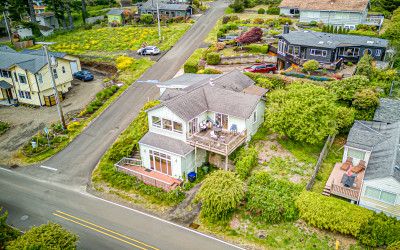
Jacqueline lives in an area zoned R3, yet there is nothing denser than a single home in her zone. She explained that these parts of the town have already been filled with single family homes, leaving no room for higher density. Yet there are other parts of town with vacant and distressed lots that could easily accommodate new middle housing, creating more options for working families, young people, and aging residents.
Other people expressed concerns about why the zoning change was being proposed at all, if the state does not require it for towns of Yachat’s size. They believed it would open up the town to big developers who would build as densely as possible, as quickly as possible—potentially even tearing down existing single detached homes to build new density.
Contrary to these concerns, just allowing middle housing will not result in massive changes in density. In fact, some cities find that they need to actively educate the public about ADUs and middle housing if they want to see significant uptake. Almost all existing single-detached homes remain single detached homes, while those who need to expand or downsize will have the freedom to do so.
One resident cited a lack of data for how these changes would affect a small town like Yachats. It's true that policy research is lacking for very small towns, which presents an additional challenge for housing advocates. We encourage researchers to quantitatively track the economic and social impacts of middle housing in very small towns. However, initial trials from other small towns indicate the benefits of these changes, regardless of city size.
I can speak to that: For the past year, I have been traveling around the state and meeting with planners, city councilors, residents, and advocates in small towns. Each town that has implemented similar changes has said that they benefit from these changes just as much, if not more, compared to big cities. Small towns are often highly resource-constrained, with limited infrastructure budgets. Infill development allows the town to use existing infrastructure more efficiently, gather more revenue, and steward their limited resources more effectively. A small investment in middle or workforce housing can have a big impact on the economic vitality of a small town.
Like many small towns, Yachats also struggles with water and transportation infrastructure–including parking—and these remain hot-button issues for residents concerned about growth. Some communities facing water constraints turn towards water efficiency measures, such as requiring all new construction to implement water sensitivity and efficiency standards. Three water-efficient cottages generally use less water, energy, and land than one large home with a large grass yard.
Some residents expressed concerns about the possible impact of new development on the environment. However, it is damaging when people falsely conflate population growth with ecological damage. The number of people present in an area is generally not what determines a community’s environmental impact; environmental impact is determined by consumption and development patterns. In fact, creating compact, walkable neighborhoods where people can work, shop, and play without driving long distances is one of the best strategies for reducing climate emissions and other pollution. These types of neighborhoods have the added benefits of improving public health, creating stronger communities, and improving affordability across all income levels.
Housing Needs Assessment timeline
Another concern expressed by residents was that the process was just “moving too fast.” They were frustrated by the lack of direct outreach and communication about the process. In fact, this process began in 2022, and has included public engagement at every step.
It all started when Yachats was provided a grant from the Department of Land Conservation and Development to engage in housing analysis and planning work. This analysis, known as the Housing Needs Assessment or HNA, showed that the way Yachats had historically been developed meant that large, single-detached homes occupy the vast majority of lands that had been intended for commercial and multifamily homes, leaving very little land left to build enough variety and size of homes that would satisfy the needs of existing and future residents.
Smaller homes, like cottages and duplexes, are generally more affordable than large homes on large lots, yet they were not permitted for the last few decades. Today, Yachats has a severe deficiency of homes that are affordable to workers and younger residents, many of whom live with their parents, commute from out of town, or live in unsafe or crowded conditions.
After analyzing the community’s housing challenges, the city of Yachats created a plan to take action, known as the Housing Implementation Plan, or HIP. Staff and planning commissioners developed recommendations to increase the types of housing that can be developed, which would allow for more homes at lower price points than are currently available.
“I see people weekly who can’t afford to live here, people who work in Yachats and are living in the woods, sleeping in tents, or renting and sharing 8 people to a house and sleeping in shifts. I mean, that is the reality—or families that are priced out of Yachats, that would love to raise a child here but can’t. So we need to work together to find a solution that provides affordable housing, that increases the land that can be developed without changing the character.”
—Bob Barrett
In his public comment, local resident Bob Barrett disagreed that the process was rushed. As someone who has been paying attention to city planning for years, he keeps asking, “What’s taking so long? I see people weekly who can’t afford to live here, people who work in Yachats and are living in the woods, sleeping in tents, or renting and sharing 8 people to a house and sleeping in shifts. I mean, that is the reality—or families that are priced out of Yachats, that would love to raise a child here but can’t. So we need to work together to find a solution that provides affordable housing, that increases the land that can be developed without changing the character.”
Resident Kathy Theilacker agreed: “This effort is to plan for the anticipated housing demand over the next 20 years. It’s not to increase the population per se, but to make sure that this community can support the anticipated population.”
She explained that if current zoning stays, there will actually be a surplus of single detached homes, and a shortage of other housing types. Instead, the city can make code changes that will allow for a larger variety of home types at different price points that can support a greater number of people.
One resident, Paul Thompson, pushed back on this notion: “We’ve been hearing a lot about perceived housing shortages, I say perceived because this is a little town, and you can’t control the whole thing like it looks is going to try to be done. [...] You’ve got too many variables, you’ve got the retirees, you’ve got the workforce people, and all that. And if workforce people can’t afford to live in Yachats, well, so be it. They can go live somewhere else. And it’s not the NIBMY thing; I just think that doing all that you’re trying to do here with these changes just won’t get it done.”
It’s worth noting whose voices were not heard at the meeting. Everyone who spoke was a current resident, and almost all were retired homeowners. We did not hear from the families who left because they were priced out, or the local workers who were at their jobs or who commute hours each day from another town. We did not hear from the people living in the woods, or the ones sharing a moldy basement with multiple roommates.

Additional paths to housing affordability
It is true that these zoning changes will not fix the affordability problem on their own. The city has been clear that this is just the first step, but much more work must be done to improve affordability in the town. To help residents and city officials understand what policies can improve housing affordability, attainability, and accessibility in towns of all sizes, 1000 Friends created the Housing Solutions Center. This website provides concise, understandable information about Oregon’s housing needs and policy tools for cities to take steps in the right direction.
Some people I spoke with expressed interest in a vacant homes tax. In Yachats, around 60% of the homes are left vacant for most of the year. These houses rely on publicly funded infrastructure, yet their owners contribute little to the local economy. Yachats already has a code provision limiting short-term rentals, listed by AirBnB or Vrbo. But a vacant homes tax would go further and address the second homes that are fully vacant most of the year.
A bold new proposal called the Astoria Housing Initiative, would do just that—tax vacant homes and use the revenue to fund community housing goals in Astoria. It will also incentivize second-homeowners to sell or rent these vacant homes, opening up more options for full time residents and workers. This initiative, which recently qualified for the fall ballot in Astoria, has the potential to set a powerful precedent for other communities considering options to address chronic vacancy.
Before leaving the Yachats, I had the joy of walking down the beach during one of the lowest low tides of the year. I was struck by the diversity and density of life, coexisting and thriving at all different scales. Like the beautiful tidepools that people come from all over to visit, Yachats is a dynamic and changing place. Residents have an opportunity to embrace change and be a part of envisioning how their town can adapt and grow over time.
Learn more about our housing work
Check out the Housing Solutions Center